04 — Publications / Explainer
When AI keeps polishing its advice,
it improves only for the first few rounds
An AI agent turned explainable AI results into advice for farmers, and crop scientists and AI judges scored every version
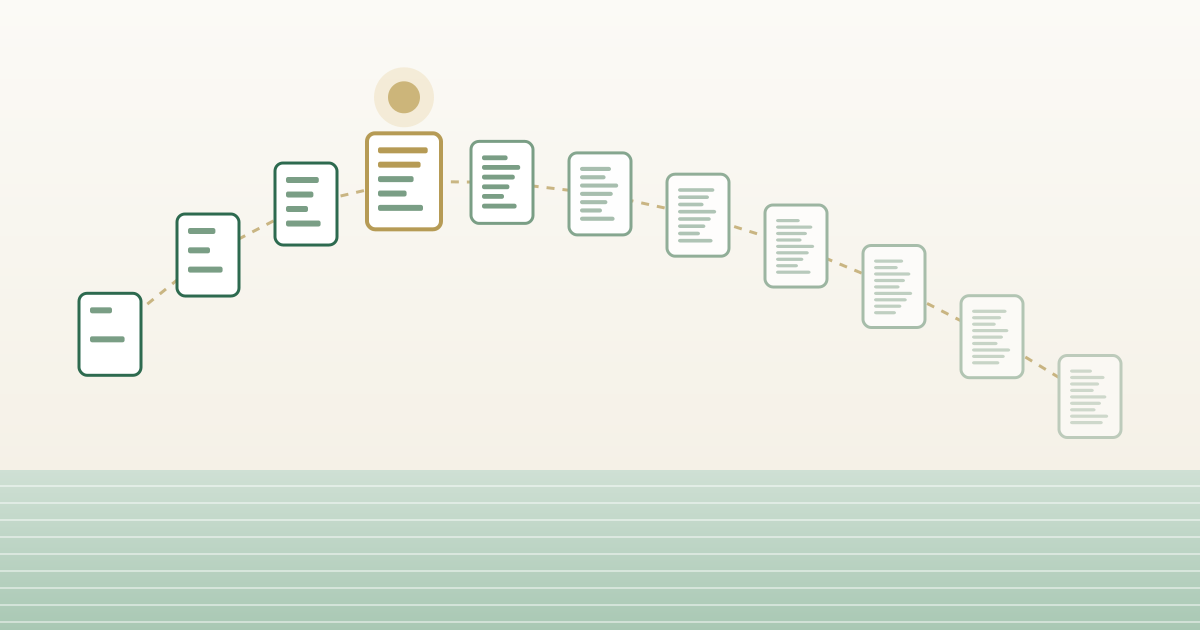
Machine learning can show what drives rice yield, but putting those results into words that farmers can use is hard. We asked a large language model (LLM) to run extra analyses and rewrite its advice for farmers ten times. When 12 crop scientists scored every version, the advice was best in the third round. After that it got worse, and by round 10 it scored below the first draft. Letting an AI polish its own advice works only if someone knows when to stop.
Key points
- Rewriting raised the scores by about a third. The best versions came in rounds 3 and 4. After that the scores fell, and in the experts' eyes round 10 was worse than the first draft.
- Early versions were vague, and later ones grew long and abstract. The AI also wrote more and more about costs, even though the data held no economic information.
- LLM judges gave scores 1.4 to 2.3 points higher than the experts. Even so, they ranked the rounds in much the same order. The worst judge was the same AI that had written the advice.
Turning AI analysis into words for the field
With machine learning, we can search yield records for the factors that raise or lower yield. Methods that show why an AI made its prediction, in a form people can follow, are called explainable AI (XAI). A popular one, SHAP, draws a chart of how much each factor pushed the yield up or down.
These charts are made for researchers, though. A farmer cannot read one and know what to do in the field tomorrow. If the results do not get across, people will not trust the AI's predictions, and the tools will go unused.
Large language models such as ChatGPT may help. They are good at turning technical explanations into everyday language. They are also used more and more as "AI agents" that plan their own steps, run extra analyses, and check their answers as they go.
So if an AI agent keeps polishing an explanation, does the advice keep getting better? We suspected not. An explanation that is too short leaves out important points. One that is too long buries them. Somewhere in between, there should be a level of detail that works best.
In this study, an AI agent rewrote its advice round after round, and we tracked how the quality changed. Both crop scientists and LLMs scored the results.
Ten rounds of rewriting by an AI
Data from 28 rice fields in Fukushima
We used data from 28 rice fields run by a single farm business in Tomioka, Fukushima Prefecture, covering about 7.5 ha in total. The farm grew four varieties from 2021 to 2023, which gave 66 field-year records.
The model drew on 37 variables. Seven described the soil, such as organic matter and nitrogen. Ten described management, such as the variety, days to heading (when the grain heads emerge), direct seeding or transplanting, and whether the field was farmed organically. The other 20 described the weather, with temperature, rain, and sunlight for each of four growth stages. Yields were estimated from drone images with AI, a method we describe in another explainer.
A random forest, a common machine learning method, predicted yield from these variables. We tested it by hiding one record at a time and predicting it, and the model scored an R² of 0.749 (1 would mean perfect predictions). We then ran SHAP on the model and summarized the 20 most influential factors in a single chart. That chart was the AI agent's starting point.
Three steps, repeated
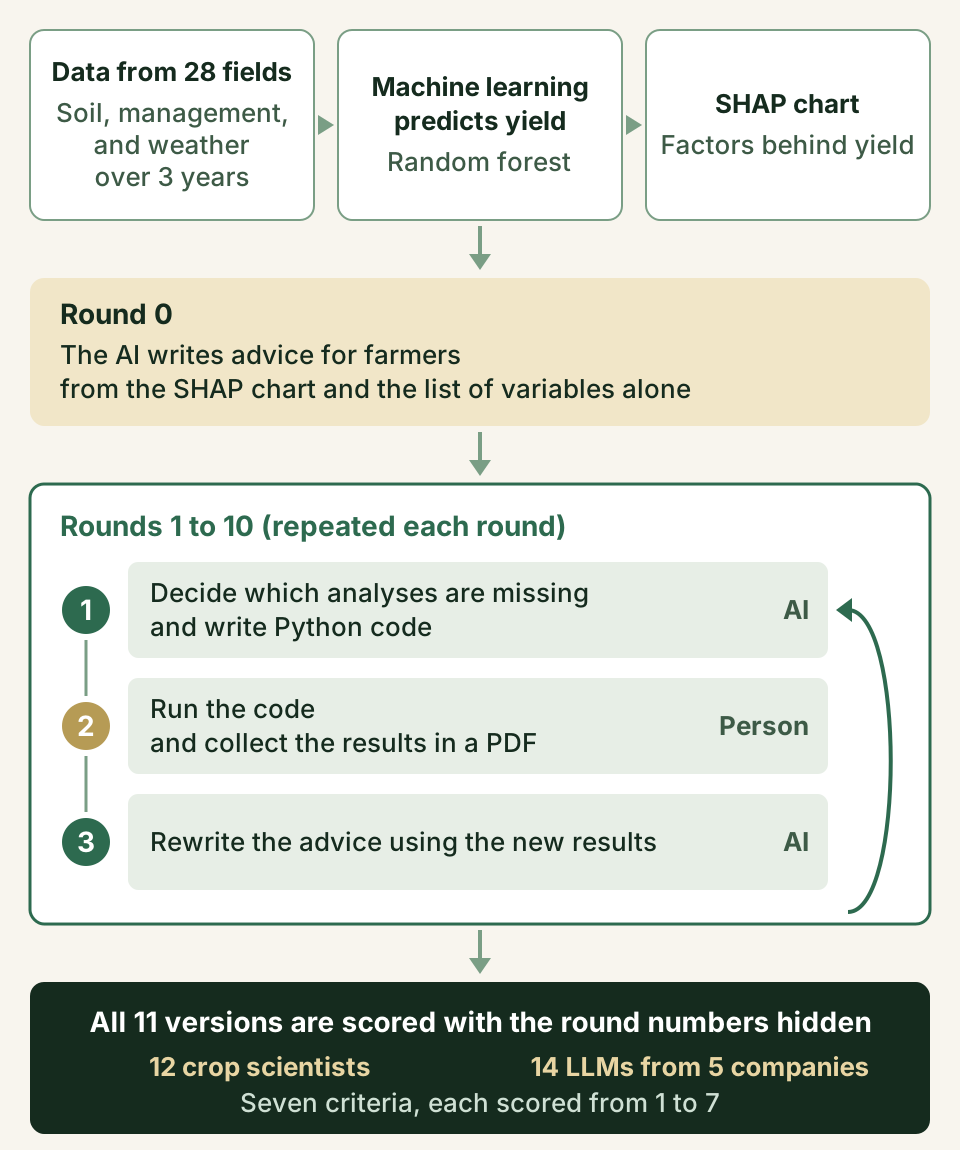
The advice was written by Claude Sonnet 4 from Anthropic. In round 0, the AI saw only the SHAP chart and the list of 37 variables, and it wrote advice for farmers from those alone (Figure 1).
Rounds 1 to 10 each followed the same three steps. First, the AI reviewed its own advice, chose what to check, and wrote Python code for the analysis. Next, a person ran that code on the field data and gathered the tables and charts in a PDF. Finally, the AI rewrote its advice using the PDF and the SHAP chart. The whole conversation was kept, so each round could build on all the results that came before.
Blind scoring by experts and by AI
Two groups scored the 11 versions. The first was 12 crop scientists, all with doctorates and all current or former members of the Crop Science Society of Japan. The second was 14 LLMs from five companies (OpenAI, Anthropic, xAI, DeepSeek, and Google). Having LLMs grade text is known as "LLM-as-a-judge." It is quicker and cheaper than asking people, so it can cover far more cases.
The advice was scored on seven criteria.
- Specificity asks whether the advice gives numbers, methods, or steps a farmer can use directly.
- Clarity asks whether it is easy to follow, with a clear line of reasoning.
- Conciseness asks whether a busy farmer could read it quickly during a work break.
- Practicality asks whether the advice is doable with the labor, skills, and time a typical farm has.
- Contextual relevance asks whether it fits the region, varieties, field sizes, and management in the data.
- Cost consideration asks whether it weighs costs and the return on spending.
- Crop science credibility asks whether it is sound from a crop science point of view.
Each criterion was scored from 1 (very poor) to 7 (excellent). Every scorer saw the versions in a different random order, and no one was told which round a version came from. Each LLM scored in a fresh chat, with no earlier conversation to sway it.
Better only up to rounds 3 and 4
A peak at rounds 3 and 4, then a decline
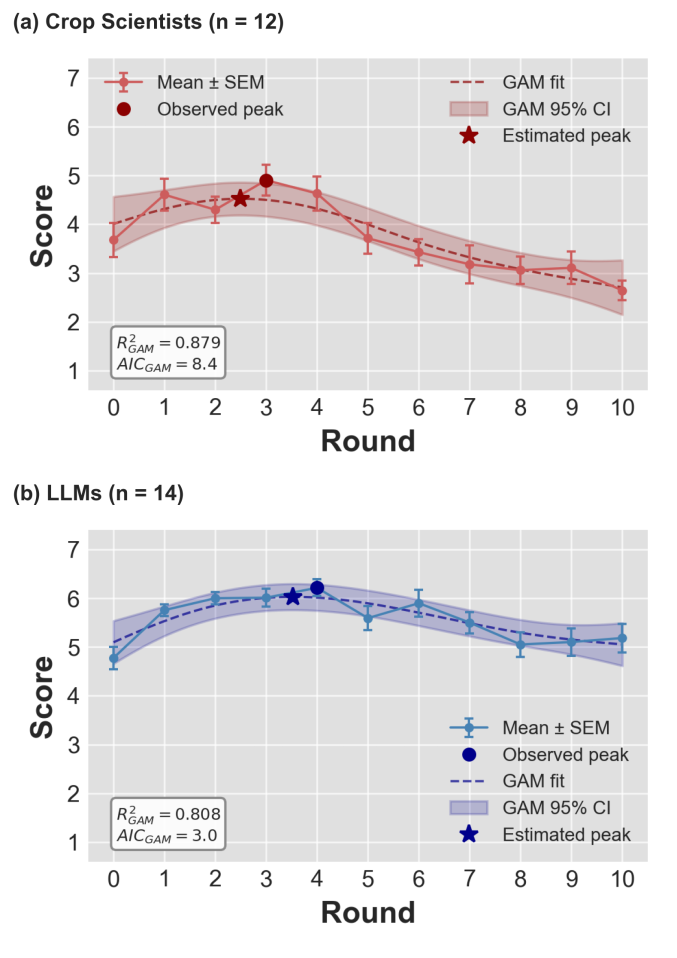
In both groups, the average of the seven criteria rose and then fell (Figure 2). The crop scientists' average climbed from 3.68 in round 0 to 4.91 in round 3, then dropped to 2.64 by round 10. Round 10 scored lower than the unrevised first draft.
The LLMs' average rose from 4.78 in round 0 to 6.21 in round 4 and ended at 5.18 in round 10. Both groups saw a gain of about a third (30 to 33%) at the peak.
Vague words became numbers
The advice itself shows why the scores rose. Figure 3 puts round 0 and round 3 side by side on one topic, managing temperature early in the season.
Round 0 already named the right levers, such as choosing varieties and setting the water depth. But it left them vague, with words like "appropriate" and "shallow." By round 3 the same points had become thresholds a farmer could check, such as the first 40 days after transplanting, a water depth of 3 to 5 cm, and maximum temperatures below 22 °C for more than 5 days in a row. Each came with an action to take. Among the experts' scores, specificity rose the most (by 2.17 points).
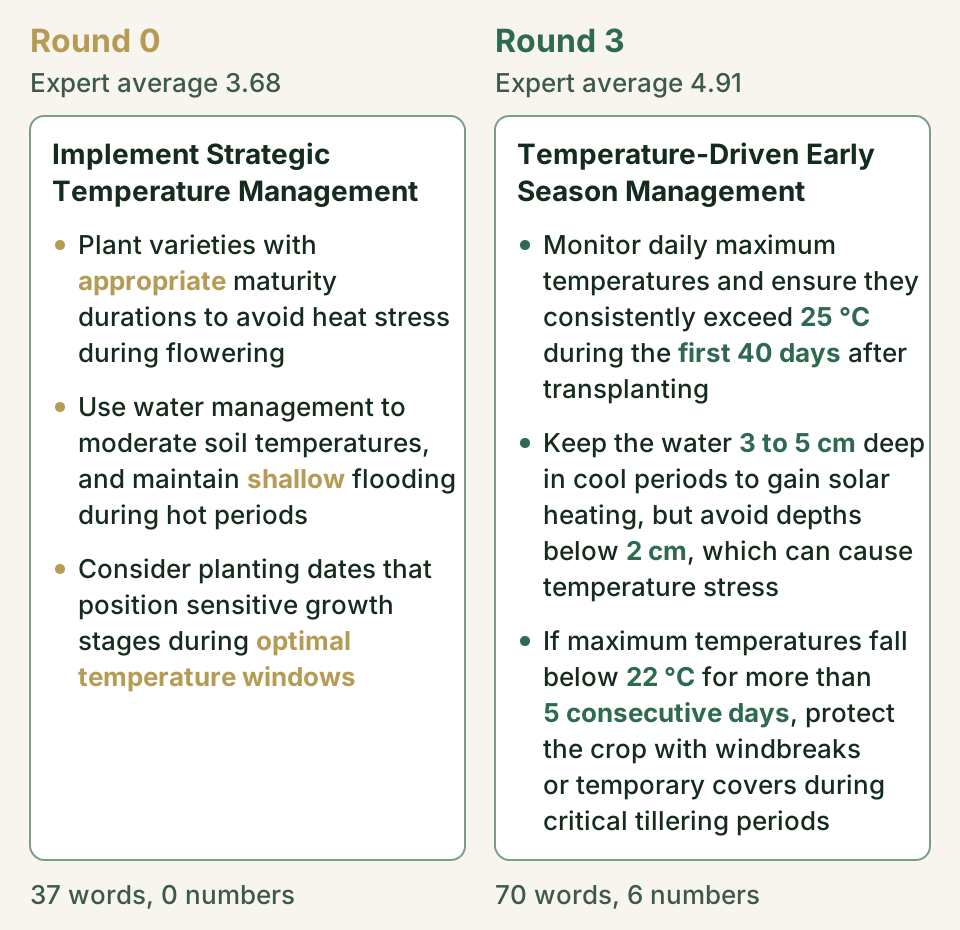
The advice in Figure 3 was written by the AI. We have not corrected its content and do not vouch for it.
The analysis kept growing
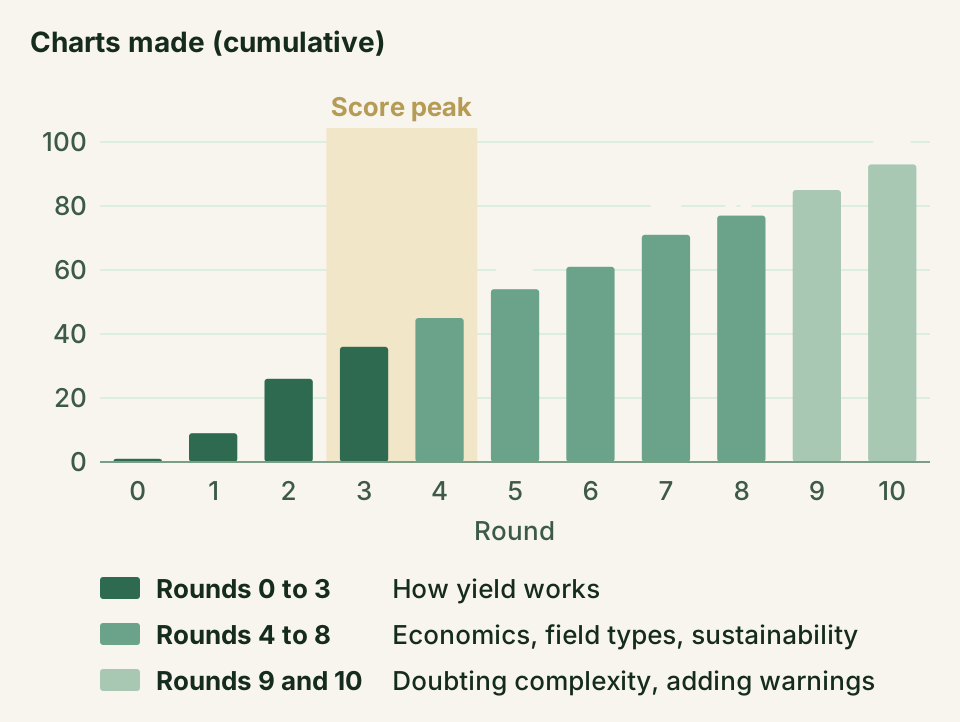
The AI's analysis expanded with every round (Figure 4). New statistical methods and chart types appeared almost every time, and the total number of charts grew from 1 in round 0 to 93 by round 10.
The focus shifted too. Rounds 0 to 3 looked at how yield is formed and how management and weather interact. Rounds 4 to 8 moved on to returns on investment, field types, and long-term sustainability. In rounds 9 and 10, the AI began to ask whether all this complexity actually helped farmers, and turned to summing up its advice with warnings about risk.
Each criterion moved in its own way
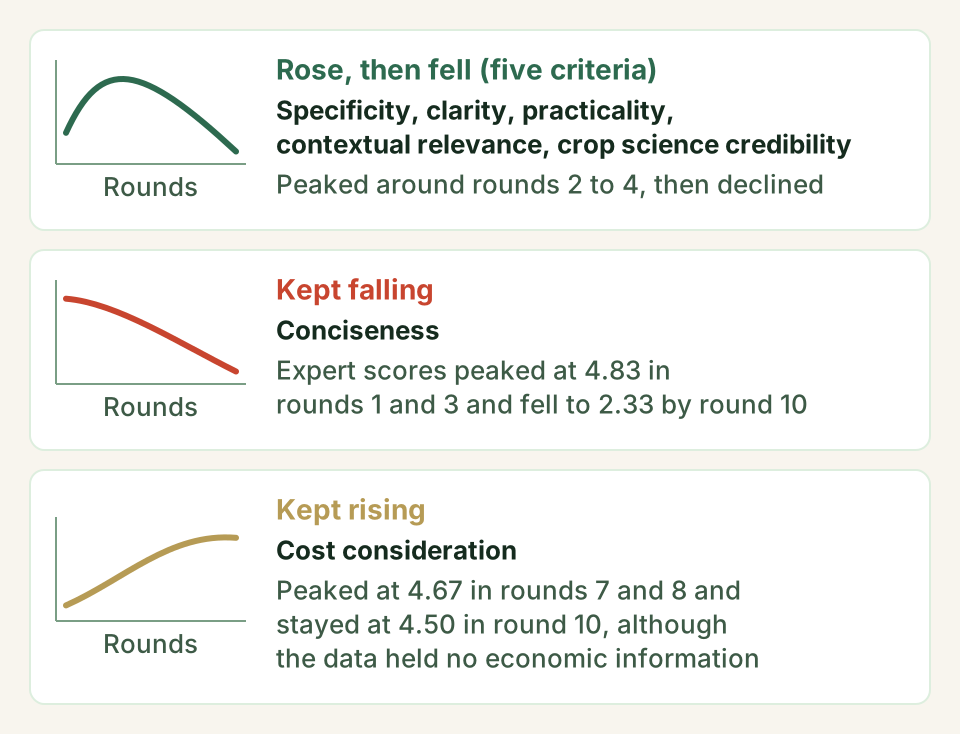
Looked at one by one, the seven criteria followed three patterns (Figure 5). Specificity, clarity, practicality, contextual relevance, and crop science credibility peaked around rounds 2 to 4 and then declined. In the LLMs' scores, clarity was the exception and stayed high throughout. Conciseness fell almost from the start, because the advice kept getting longer.
Cost consideration was the only criterion that kept rising. Yet the data contained no economic information at all, not even costs or rice prices. The AI was building up economic arguments that sounded convincing but had nothing in the data behind them.
Early versions lacked specific detail. Too many rounds brought length, abstraction, and claims without support. The best advice lay between too little explanation and too much. In machine learning terms, this resembles the trade-off between bias and variance.
LLM judges were generous, but ranked the rounds well
On every criterion, the LLMs scored 1.4 to 2.3 points higher than the experts (Figure 6). On a 7-point scale, that is a large gap, so an LLM's score cannot stand in for an expert's.
Still, the two groups mostly agreed on which rounds were better and which were worse. Their rankings had a Spearman correlation (ρ) of 0.58 to 0.90, where 1 means identical order. For the seven criteria and the average alike, the two groups' best rounds were never more than one round apart.
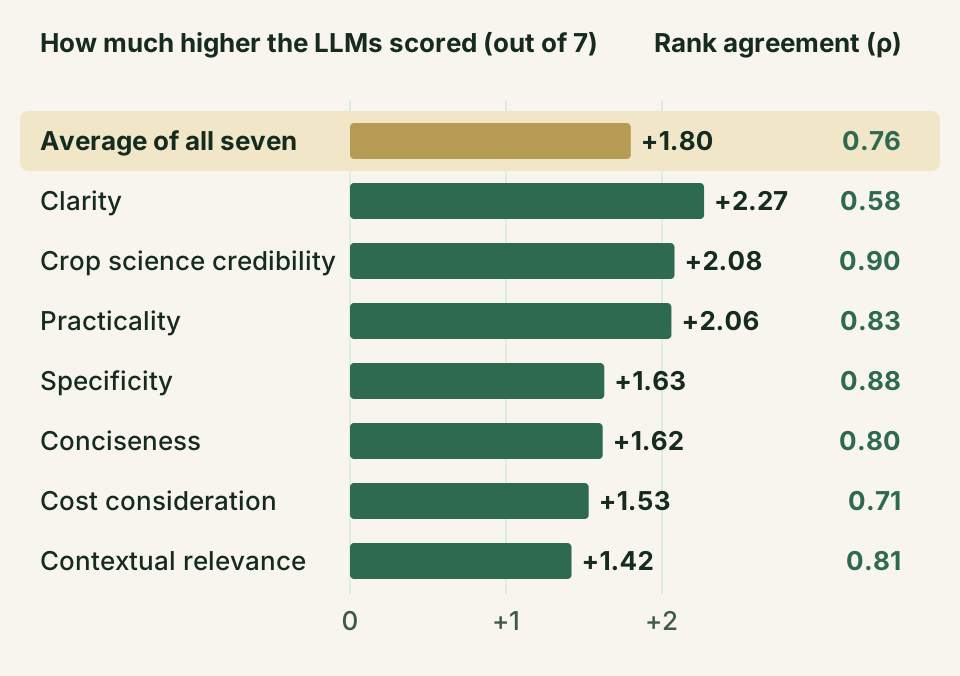
Individual LLMs, however, varied widely. The best at finding the experts' top round was Gemini 3.0 Pro, which came within one round on seven of the eight scores (the seven criteria plus the average). The worst was Claude Sonnet 4, which did so on only one. Claude Sonnet 4 was also the AI that wrote the advice. This suggests that an AI should not be left to grade its own work.
Knowing when to stop, and keeping a record
More rewriting did not make the advice better and better. It improved over the first few rounds, and after that it grew longer and more abstract, with more unsupported content. Any system that lets an AI agent polish its explanations needs a stopping point built in from the start.
Who decides when to stop
Asking experts to score every round would take far too much of their time. The LLM judges were generous with their scores but largely tracked which rounds were better. That suggests LLMs could do the job of signaling when to stop.
We propose a simple procedure. First, experts score one small trial, just once. Next, LLMs are compared against those expert scores, and only the ones that agree well are kept as judges. Models from the same family as the writing AI are left out. In later runs, the chosen LLMs score each round, and the loop stops once the scores stop improving. Experts then check only the final version.
Publishing every step
Code that an AI writes for itself can contain mistakes. And with every round, farmers are asked to trust more things at once. They must trust the original model, the SHAP chart, the AI's own code and analyses, and the advice that pulls them together.
For this study, we published the prompts and every round's code, charts, and advice on Zenodo, a public repository for research data (https://doi.org/10.5281/zenodo.17876329). We believe advice from an AI agent can only be trusted when anyone can check how it was made.
What we do not know yet
- This paper is a preprint. It has not yet been through peer review at a journal.
- The results come from the fields of one farm in Fukushima. We have not tested whether other crops or regions show the same pattern.
- Only one AI, Claude Sonnet 4, wrote the advice. The LLM judges may also share habits, especially models from the same company.
- The advice was scored when it was written. We have not yet studied what happens when farmers actually follow it.
Next steps
Most important of all is to have farmers judge the advice themselves, since they are the ones who will use it. We also want to see whether giving the AI new data or published research at the peak can push the quality a step higher. We plan to test these ideas with other crops and in other subject areas.
Glossary
- Explainable AI (XAI)
- Methods that show why an AI made a prediction, in a form people can understand.
- SHAP
- A method that measures how much each factor pushed a prediction up or down.
- Large language model (LLM)
- An AI that learns from huge amounts of text and can read and write much as people do. ChatGPT, Claude, and Gemini are examples.
- AI agent
- A way of using AI in which it works toward a goal on its own, planning steps, using tools, and checking its results along the way.
- Agentic XAI
- The approach proposed in this study. An AI agent repeatedly refines its explanation of XAI results in search of a better one.
- Machine learning (random forest)
- Machine learning lets a computer learn patterns from data. A random forest builds many yes-or-no decision trees and averages their answers.
- LLM-as-a-judge
- Using an LLM to score the quality of a piece of text.
- Bias-variance trade-off
- An idea from machine learning. A model that is too simple misses important patterns (bias), and one that is too complex picks up random noise (variance). This study suggests that the detail in an explanation works in a similar way.
- Spearman's rank correlation (ρ)
- A number that shows how closely two rankings agree. A value of 1 means the order is exactly the same.
About the paper
Tomoaki Yamaguchi, Yutong Zhou, Masahiro Ryo & Keisuke Katsura (2025). Agentic Explainable Artificial Intelligence (Agentic XAI) Approach To Explore Better Explanation: A Case Study in Decision Support for Rice Cultivation in Japan. arXiv, 2512.21066. https://doi.org/10.48550/arXiv.2512.21066
This paper is a preprint that has not yet been peer reviewed. Anyone can read it free on arXiv, under the CC BY 4.0 license. Figure 2 is reproduced from the paper, Figure 3 is adapted from one of its figures, and Figures 4 to 6 were drawn from values reported in it.